







Chapter 2C. Warning Signs
Section 2C.01 Function of Warning Signs
Support:
Warning signs call attention to unexpected conditions on or adjacent
to a highway or street and to situations that might not be readily
apparent to road users. Warning signs alert road users to conditions
that might call for a reduction of speed or an action in the interest
of safety and efficient traffic operations.
Section 2C.02 Application of Warning Signs
Standard:
The use of warning signs shall be based on an engineering study
or on engineering judgment.
Guidance:
The use of warning signs should be kept to a minimum as the unnecessary
use of warning signs tends to breed disrespect for all signs. In
situations where the condition or activity is seasonal or temporary,
the warning sign should be removed or covered when the condition
or activity does not exist.
Support:
The categories of warning signs are shown in Table 2C-1.
| Category | Group | Section | Signs | MUTCD Codes |
|---|---|---|---|---|
| Roadway Related |
Changes in Horizontal Alignment |
2C.06 | Turn, Curve, Reverse Turn, Reverse Curve, Winding Road, Hairpin Curve, 270-Degree Curve | W1-1 through W1-5, W1-11, W1-15 |
| 2C.07 | Combination
Horizontal Alignment/Advisory Speed |
W1-1a , W1-2a | ||
| 2C.08 | Combination
Horizontal Alignment/Intersection |
W1-10 | ||
| 2C.09 | Large Arrow (one direction) | W1-6 | ||
| 2C.10 | Chevron Alignment | W1-8 | ||
| 2C.11 | Truck Rollover | W1-13 | ||
| Vertical Alignment | 2C.12 | Hill | W7-1, W7-1a, W7-1b | |
| 2C.13 | Truck Escape Ramp | W7-4, W7-4a | ||
| 2C.14 | Hill Blocks View | W7-6 | ||
| Cross Section | 2C.15 | Road Narrows | W5-1 | |
| 2C.16-17 | Narrow Bridge, One Lane Bridge | W5-2, W5-3 | ||
| 2C.18-20 | Divided Road, Divided Road Ends, Double Arrow | W6-1, W6-2, W12-1 | ||
| 2C.21 | Dead End, No Outlet | W14-1, W14-1a, W14-2, W14-2a | ||
| 2C.22 | Low Clearance | W12-2, W12-2p | ||
| Roadway Surface Condition | 2C.23-24 | Bump, Dip, Speed Hump | W8-1, W8-2, W17-1 | |
| 2C.25 | Pavement Ends | W8-3 | ||
| 2C.26 | Shoulder | W8-4, W8-9, W8-9a | ||
| 2C.27 | Slippery When Wet | W8-5 | ||
| 2C.28 | Bridge Ices Before Road | W8-13 | ||
| Traffic Related | Advance Traffic Control | 2C.29-30 | Stop Ahead, Yield Ahead, Signal Ahead, Be Prepared To Stop, Speed Reduction | W3-1, W3-2, W3-3, W3-4, W3-5, W3-5a |
| Traffic Flow | 2C.31-35 | Merge, Lane Ends, Added Lane, Two-Way Traffic, Right Lane Ends, Lane Ends Merge Left, No Passing Zone | W4-1, W4-2, W4-3, W4-5, W4-6, W6-3, W9-1, W9-2, W14-3 | |
| Change in Speed | 2C.36 | Advisory Speed | W13-2, W13-3, W13-5 | |
| Intersections | 2C.37 | Cross Road, Side Road, T, Y, and Circular Intersection | W2-1 through W2-6 | |
| 2C.38 | Large Arrow (two directions) | W1-7 | ||
| 2C.39 | Oncoming Extended Green | W25-1, W25-2 | ||
| Vehicular Traffic | 2C.40 | Truck Crossing, Truck (symbol), Emergency Vehicle, Tractor, Bicycle, Golf Cart, Horse-Drawn Vehicle | W8-6, W11-1, W11-5, W11-5a, W11-8, W11-10, W11-11, W11-12P, W11-14 | |
| Nonvehicular | 2C.41-42 | Pedestrian, Deer, Cattle, Snowmobile, Horse, Wheelchair, Playground | W11-2, W11-3, W11-4, W11-6, W11-7, W11-9, W15-1 | |
| Supplemental Plaques | Distance |
2C.45 | XX Feet, XX Miles, Next XX Feet, Next XX MI | W16-2, W16-3, W16-4, W7-3a |
| Speed | 2C.46 | Advisory Speed | W13-1 | |
| Arrow | 2C.47 | Advance Arrow, Directional Arrow, Diagonal Arrow | W16-5p, W16-6p, W16-7p | |
| Hill-Related | 2C.48 | Trucks Use Low Gear, X% Grade | W7-2, W7-3 | |
| Street Name Plaque | 2C.49 | Advance Street Name | W16-8 | |
| Intersection | 2C.50 | Cross Traffic Does Not Stop | W4-4p | |
| Share The Road | 2C.51 | Share The Road | W16-1 | |
| HOV | 2C.52 | High-Occupancy Vehicle | W16-11 | |
| Photo Enforced | 2C.53 | Photo Enforced | W16-10 | |
| Traffic Circle | 2C.37 | Traffic Circle | W16-12p |
Warning signs specified herein cover most of the conditions that are likely to be encountered. Additional warning signs for low-volume roads (as defined in Section 5A.01), temporary traffic control zones, school areas, highway-rail grade crossings, bicycle facilities, and highway-light rail transit grade crossings are discussed in Parts 5 through 10, respectively.
Option:
Word message warning signs other than those specified in this Manual
may be developed and installed by State and local highway agencies.
Section 2C.03 Design of Warning Signs
Standard:
All warning signs shall be diamond-shaped (square with one diagonal
vertical) with a black legend and border on a yellow background
unless specifically designated otherwise. Warning signs shall be
designed in accordance with the sizes, shapes, colors, and legends
contained in the "Standard Highway Signs" book (see Section
1A.11) .
Option:
Warning signs regarding conditions associated with pedestrians,
bicyclists, playgrounds, school buses, and schools may have a black
legend and border on a yellow background or a black legend and border
on a fluorescent yellow-green background.
Section 2C.04 Size of Warning Signs
Standard:
The sizes for warning signs shall be as shown in Table 2C-2.
| Description | Conventional Road | Expressway | Freeway | Minimum | Oversized | |
|---|---|---|---|---|---|---|
| Shape | Sign Series | |
|
|
|
|
| Diamond | W1, W2, W7, W8, W9, W11, W14, W15-1, W17-1 | 750
x 750 (30 x 30) |
900
x 900 (36 x 36) |
1200
x 1200 (48 x 48) |
600
x 600 (24 x 24) |
—— |
| W1 Combination, W3, W4, W5, W6, W8-3, W10, W12 | 900
x 900 (36 x 36) |
1200
x 1200 (48 x 48) |
1200
x 1200 (48 x 48) |
750
x 750 (30 x 30) |
—— | |
| Rectangular | W1 - Arrows | 1200
x 600 (48 x 24) |
—— | —— | 900
x 450 (36 x 18) |
1500
x750 (60 x 30) |
| W1 - Chevron | 450
x 600 (18 x 24) |
750
x 900 (30 x 36) |
900
x1200 (36 x 48) |
300
x 450 (12 x 18) |
—— | |
| W7-4 | 1950
x 1200 (78 x 48) |
1950
x 1200 (78 x 48) |
1950
x 1200 (78 x 48) |
—— | —— | |
| W7-4b, 4c | 1950
x 1500 (78 x 60) |
1950
x 1500 (78 x 60) |
1950
x 1500 (78 x 60) |
—— | —— | |
| W10-9, 10 | 600
x 450 (24 x 18) |
—— | —— | —— | —— | |
| W12-2p | 2100
x 600 (84 x 24) |
2100
x 600 (84 x 24) |
2100
x 600 (84 x 24) |
—— | —— | |
| W13-2, 3, 5, W25 | 600
x 750 (24 x 30) |
900
x1200 (36 x 48) |
1200
x 1500 (48 x 60) |
600
x 750 (24 x 30) |
1200
x 1500 (48 x 60) |
|
| Pennant | W14-3 | 900
x 1200 x 1200 (36 x 48 x 48) |
—— | —— | 750
x 1000 x 1000 (30 x 40 x 40) |
1200
x1600 x 1600 (48 x 64 x 64) |
| Circular | W10-1 | 900
(36) Dia. |
1200
(48) Dia. |
—— | 750
(30) Dia. |
1200
(48) Dia. |
- Larger signs may be used when appropriate
- Dimensions are shown in millimeters followed by inches in parentheses and are shown as width x height
Guidance:
The Conventional Road size should be used on conventional roads.
The Freeway and Expressway sizes should be used for higher-speed applications to provide larger signs for increased visibility and recognition.
Option:
The Minimum size may be used on low-speed roadways where the reduced
legend size would be adequate for the warning or where physical
conditions preclude the use of the other sizes.
Oversized signs and larger sizes may be used for those special applications where speed, volume, or other factors result in conditions where increased emphasis, improved recognition, or increased legibility would be desirable.
Standard:
The minimum size for supplemental warning plaques shall be as shown
in Table 2C-3.
| Size of Warning Sign | Size of Supplemental Plaque | |||
|---|---|---|---|---|
| Rectangular | Square | |||
| 1 Line | 2 Lines | Arrow | ||
| 600 x 600
(24 x 24) 750 x 750 (30 x 30) |
600 x 300 (24 x 12) | 600 x 450 (24 x 18) | 600 x 300 (24 x 12) | 450 x 450 (18 x 18) |
| 900
x 900 (36 x 36) 1200 x 1200 (48 x 48) |
750 x 450 (30 x18) | 750 x 600 (30 x 24) | 750 x 450 (30 x 18) | 600 x 600 (24 x 24) |
- Larger supplemental plaques may be used when appropriate
- Dimensions are shown in millimeters followed by inches in parentheses and are shown as width x height
Option:
Signs larger than those shown in Tables 2C-2 and 2C-3 may be used
(see Section 2A.12).
Section 2C.05 Placement of Warning Signs
Support:
For information on placement of warning signs, see Sections 2A.16
to 2A.21.
The total time needed to perceive and complete a reaction to a sign is the sum of the times necessary for Perception, Identification (understanding), Emotion (decision making), and Volition (execution of decision), and is called the PIEV time. The PIEV time can vary from several seconds for general warning signs to 6 seconds or more for warning signs requiring high road user judgment.
Table 2C-4 lists suggested sign placement distances for two conditions. This table is provided as an aid for determining warning sign location.
Guidance:
Warning signs should be placed so that they provide adequate PIEV
time. The distances contained in Table 2C-4 are for guidance purposes
and should be applied with engineering judgment. Warning signs should
not be placed too far in advance of the condition, such that drivers
might tend to forget the warning because of other driving distractions,
especially in urban areas.
Minimum spacing between warning signs with different messages should be based on the estimated PIEV time for driver comprehension of and reaction to the second sign.
The effectiveness of the placement of warning signs should be periodically evaluated under both day and night conditions.
Option:
Warning signs that advise road users about conditions that are not
related to a specific location, such as Deer Crossing or SOFT SHOULDER,
may be installed in an appropriate location, based on engineering
judgment, since they are not covered in Table 2C-4.
1 The distances are adjusted for a sign legibility distance of 50 m for Condition A. The distances for Condition B have been adjusted for a sign legibility distance of 75 m, which is appropriate for an alignment warning symbol sign.
2 Typical conditions are locations where the road user must use extra time to adjust speed and change lanes in heavy traffic because of a complex driving situation. Typical signs are Merge and Right Lane Ends. The distances are determined by providing the driver a PIEV time of 14.0 to 14.5 seconds for vehicle maneuvers (2001 AASHTO Policy, Exhibit 3-3, Decision Sight Distance, Avoidance Maneuver E) minus the legibility distance of 50 m for the appropriate sign.
3 Typical condition is the warning of a potential stop situation. Typical signs are Stop Ahead, Yield Ahead, Signal Ahead, and Intersection Warning signs. The distances are based on the 2001 AASHTO Policy, Stopping Sight Distance, Exhibit 3-1, providing a PIEV time of 2.5 seconds, a deceleration rate of 3.4 m/second2, minus the sign legibility distance of 50 m.
4 Typical conditions are locations where the road user must decrease speed to maneuver through the warned condition. Typical signs are Turn, Curve, Reverse Turn, or Reverse Curve. The distance is determined by providing a 2.5 second PIEV time, a vehicle deceleration rate of 3 m/second2, minus the sign legibility distance of 75 m.
5 No suggested distances are provided for these speeds, as the placement location is dependent on site conditions and other signing to provide an adequate advance warning for the driver.
| Posted or 85th-Percentile Speed | Advance Placement Distance1 | ||||||||
|---|---|---|---|---|---|---|---|---|---|
| Condition A: Speed Reduction and Lane Changing in Heavy Traffic2 | Condition B: Deceleration to the listed advisory speed (mph) for the condition4 | ||||||||
| 03 | 10 | 20 | 30 | 40 | 50 | 60 | 70 | ||
| 20 mph | 225 ft | N/A5 | N/A5 | — | — | — | — | — | — |
| 25 mph | 325 ft | N/A5 | N/A5 | N/A5 | — | — | — | — | — |
| 30 mph | 450 ft | N/A5 | N/A5 | N/A5 | — | — | — | — | — |
| 35 mph | 550 ft | N/A5 | N/A5 | N/A5 | N/A5 | — | — | — | — |
| 40 mph | 650 ft | 125 ft | N/A5 | N/A5 | N/A5 | — | — | — | — |
| 45 mph | 750 ft | 175 ft | 125 ft | N/A5 | N/A5 | N/A5 | — | — | — |
| 50 mph | 850 ft | 250 ft | 200 ft | 150 ft | 100 ft | N/A5 | — | — | — |
| 55 mph | 950 ft | 325 ft | 275 ft | 225 ft | 175 ft | 100 ft | N/A5 | — | — |
| 60 mph | 1100 ft | 400 ft | 350 ft | 300 ft | 250 ft | 175 ft | N/A5 | — | — |
| 65 mph | 1200 ft | 475 ft | 425 ft | 400 ft | 350 ft | 275 ft | 175 ft | N/A5 | — |
| 70 mph | 1250 ft | 550 ft | 525 ft | 500 ft | 425 ft | 350 ft | 250 ft | 150 ft | — |
| 75 mph | 1350 ft | 650 ft | 625 ft | 600 ft | 525 ft | 450 ft | 350 ft | 250 ft | 100 ft |
1 The distances are adjusted for a sign legibility distance of 175 ft for Condition A. The distances for Condition B have been adjusted for a sign legibility distance of 250 ft, which is appropriate for an alignment warning symbol sign.
2 Typical conditions are locations where the road user must use extra time to adjust speed and change lanes in heavy traffic because of a complex driving situation. Typical signs are Merge and Right Lane Ends. The distances are determined by providing the driver a PIEV time of 14.0 to 14.5 seconds for vehicle maneuvers (2001 AASHTO Policy, Exhibit 3-3, Decision Sight Distance, Avoidance Maneuver E) minus the legibility distance of 175 ft for the appropriate sign.
3 Typical condition is the warning of a potential stop situation. Typical signs are Stop Ahead, Yield Ahead, Signal Ahead, and Intersection Warning signs. The distances are based on the 2001 AASHTO Policy, Stopping Sight Distance, Exhibit 3-1, providing a PIEV time of 2.5 seconds, a deceleration rate of 11.2 ft/second2, minus the sign legibility distance of 175 ft.
4 Typical conditions are locations where the road user must decrease speed to maneuver through the warned condition. Typical signs are Turn, Curve, Reverse Turn, or Reverse Curve. The distance is determined by providing a 2.5 second PIEV time, a vehicle deceleration rate of 10 ft/second2, minus the sign legibility distance of 250 ft.
5 No suggested distances are provided for these speeds, as the placement location is dependent on site conditions and other signing to provide an adequate advance warning for the driver.
Section 2C.06 Horizontal Alignment Signs (W1-1 through W1-5, W1-11, W1-15)
Option:
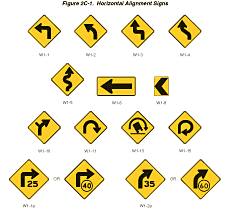
The horizontal alignment Turn (W1-1), Curve (W1-2), Reverse Turn
(W1-3), Reverse Curve (W1-4), or Winding Road (W1-5) signs (see
Figure 2C-1) may be used in advance of situations where the horizontal
roadway alignment changes. A One-Direction Large Arrow (W1-6)
sign (see Figure 2C-1 and Section 2C.09)
may be used on the outside of the turn or curve.
If the change in horizontal alignment is 135 degrees or more, the Hairpin Curve (W1-11) sign (see Figure 2C-1) may be used.
If the change in horizontal alignment is approximately 270 degrees, such as on a cloverleaf interchange ramp, the 270-degree Loop (W1-15) sign (see Figure 2C-1) may be used.
Figure 2C-1 Horizontal Alignment Signs
Guidance:
The application of these signs should conform to Table 2C-5.
| Number
of Alignment Changes |
Advisory Speed | |
|---|---|---|
| < 50 km/h (< 30 MPH) | > 50 km/h (> 30 MPH) | |
|
1
|
Turn (W1-1)1
|
Curve (W1-2)1
|
|
22
|
Reverse
Turn3 (W1-3)
|
Reverse
Curve3 (W1-4)
|
| 3 or more2 | Winding Road3 (W1-5) | |
1 Engineering judgment should be used to determine whether the Turn or Curve sign should be used.
2 Alignment changes are in opposite directions and are separated by a tangent distance of 180 m (600 ft) or less.
3 A Right Reverse Turn (W1-3R), Right Reverse Curve (W1-4R), or Right Winding Road (W1-5R) sign is used if the first change in alignment is to the right; a Left Reverse Turn (W1-3L), Left Reverse Curve (W1-4L), or Left Winding Road (W1-5L) sign is used if the first change in alignment is to the left.
When the Hairpin Curve sign or the 270-degree Loop sign is installed, either a One-Direction Large Arrow (W1-6) sign or Chevron Alignment (W1-8) signs should be installed on the outside of the turn or curve.
Option:
An Advisory Speed (W13-1) plaque (see Section
2C.46) may be used to indicate the speed for the change in horizontal
alignment. The supplemental distance plaque NEXT XX km (NEXT XX
MILES) (W7-3a) may be installed below the Winding Road sign where
continuous roadway curves exist (see Section
2C.45). The combination Horizontal Alignment/Advisory Speed
sign (see Section 2C.07), combination
Horizontal Alignment/Intersection sign (see Section
2C.08), or the Curve Speed sign (see Section
2C.36) may also be used.
Standard:
When engineering judgment determines the need for a horizontal alignment
sign, one of the W1-1 through W1-5, W1-10, W1-11 or W1-15 signs
shall be used.
Option:
If the reduction in speed is 20 km/h (15 mph)
or greater, a supplemental combination Horizontal Alignment/Advisory
Speed sign or Curve Speed (W13-5) sign may be installed as near
as practical to the point of curvature. If the reduction in speed
is 40 km/h (25 mph) or greater, one or more additional Curve Speed
signs may be installed along the curve.
Section 2C.07 Combination Horizontal Alignment/Advisory Speed Signs (W1-1a, W1-2a)
Option:
The Turn (W1-1) sign or the Curve (W1-2) sign may be combined with
the Advisory Speed (W13-1) plaque (see Section
2C.46) to create a combination Turn/Advisory Speed (W1-1a) sign
(see Figure 2C-1), or combination Curve/Advisory
Speed (W1-2a) sign (see Figure 2C-1).
Standard:
When used, the combination Horizontal Alignment/Advisory Speed sign
shall supplement other advance warning signs and shall be installed
at the beginning of the turn or curve.
Section 2C.08 Combination Horizontal Alignment/Intersection Sign (W1-10)
Option:
The Turn (W1-1) sign or the Curve (W1-2) sign may be combined with
the Cross Road (W2-1) sign or the Side Road (W2-2 or W2-3) sign
to create a combination Horizontal Alignment/Intersection (W1-10)
sign (see Figure 2C-1) that depicts the condition where an intersection
occurs within a turn or curve.
Guidance:
Elements of the combination Horizontal Alignment/Intersection sign
related to horizontal alignment should conform to Section
2C.06, and elements related to intersection configuration should
conform to Section 2C.37. No more than
one Cross Road or two Side Road symbols should be shown on any one
combination Horizontal Alignment/Intersection sign.
Section 2C.09 One-Direction Large Arrow Sign (W1-6)
Option:
A One-Direction Large Arrow (W1-6) sign (see Figure 2C-1) may be
used to delineate a change in horizontal alignment.
Standard:
The One-Direction Large Arrow sign shall be a horizontal rectangle
with an arrow pointing to the left or right.
If used, the One-Direction Large Arrow sign shall be installed on the outside of a turn or curve in line with and at approximately a right angle to approaching traffic.
The One-Direction Large Arrow sign shall not be used where there is no alignment change in the direction of travel, such as at the beginnings and ends of medians or at center piers.
Guidance:
The One-Direction Large Arrow sign should be visible for a sufficient
distance to provide the road user with adequate time to react to
the change in alignment.
Section 2C.10 Chevron Alignment Sign (W1-8)
Option:
The Chevron Alignment (W1-8) sign (see Figure 2C-1) may be used
to provide additional emphasis and guidance for a change in horizontal
alignment. A Chevron Alignment sign may be used as an alternate
or supplement to standard delineators on curves or to the One-Direction
Large Arrow (W1-6) sign.
Standard:
The Chevron Alignment sign shall be a vertical rectangle. No border
shall be used on the Chevron Alignment sign.
If used, Chevron Alignment signs shall be installed on the outside of a turn or curve, in line with and at approximately a right angle to approaching traffic.
Option:
A Chevron Alignment sign may be used on the far side of an intersection
to inform drivers of a change of horizontal alignment for through
traffic.
Guidance:
Spacing of Chevron Alignment signs should be such that the road
user always has at least two in view, until the change in alignment
eliminates the need for the signs.
Chevron Alignment signs should be visible for a sufficient distance to provide the road user with adequate time to react to the change in alignment.
Section 2C.11 Truck Rollover Warning Sign (W1-13)
Option:
A Truck Rollover Warning (W1-13) sign (see Figure 2C-1) may be used
to warn drivers of vehicles with a high center of gravity, such
as trucks, tankers, and recreational vehicles, of a curve or turn
having geometric conditions that are prone to cause such vehicles
to lose control and overturn.
Standard:
When the Truck Rollover Warning (W1-13) sign is used, it shall be
accompanied by an Advisory Speed (W13-1) plaque indicating the recommended
speed for vehicles with a higher center of gravity.
Option:
The Truck Rollover Warning sign may be displayed either as a static
sign, a static sign supplemented by a flashing warning beacon, or
as a changeable message sign activated by the detection of an approaching
vehicle with a high center of gravity that is traveling in excess
of the recommended speed for the condition.
Support:
The curved arrow on the Truck Rollover Warning sign shows the direction
of roadway curvature. The truck tips in the opposite direction.
Section 2C.12 Hill Signs (W7-1, W7-1a, W7-1b)
Guidance:
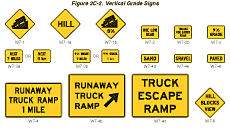
The Hill (W7-1) sign (see Figure 2C-2) should be used in advance
of a downgrade where the length, percent of grade, horizontal curvature,
and/or other physical features require special precautions on the
part of road users.
Figure 2C-2 Vertical Grade Signs
The Hill sign and supplemental grade (W7-3) plaque (see Section 2C.48) used in combination, or the W7-1b sign used alone, should be installed in advance of downgrades for the following conditions:
- 5% grade that is more than 900 m (3,000 ft) in length;
- 6% grade that is more than 600 m (2,000 ft) in length;
- 7% grade that is more than 300 m (1,000 ft) in length;
- 8% grade that is more than 230 m (750 ft) in length; or
- 9% grade that is more than 150 m (500 ft) in length.
These signs should also be installed for steeper grades or where crash experience and field observations indicate a need.
Supplemental plaques (see Section 2C.48) and larger signs should be used for emphasis or where special hill characteristics exist. On longer grades, the use of the Hill sign with a distance (W7-3a) plaque or the combination distance/grade (W7-3b) plaque at periodic intervals of approximately 1.6 km (1 mi) spacing should be considered.
Standard:
When the percent grade is shown, the message X% plaque shall be
placed below the inclined ramp/truck symbol (W7-1) or the word message
HILL (W7-1a) sign.
Option:
The word message HILL (W7-1a) sign may be used as an alternate to
the symbol (W7-1) sign. The percent grade message may be included
within these signs.
Section 2C.13 Truck Escape Ramp Signs (W7-4 Series)
Guidance:
Where applicable, truck escape (or runaway truck) ramp advance warning
signs (see Figure 2C-2) should be located
approximately 1.6 km (1 mi), and 800 m (0.5 mi) in advance of the
grade, and of the ramp. A sign also should be placed at the gore.
A RUNAWAY VEHICLES ONLY (R4-10) sign (see Figure
2B-8) should be installed near the ramp entrance to discourage
other road users from entering. No Parking (R8-3) signs should be
placed near the ramp entrance.
Standard:
When truck escape ramps are installed, at least one of the W7-4
series signs shall be used.
Option:
A SAND (W7-4d), GRAVEL (W7-4e), or PAVED (W7-4f) supplemental plaque
(see Figure 2C-2) may be used to describe the ramp surface. State
and local highway agencies may develop appropriate word message
signs for the specific situation.
Section 2C.14 HILL BLOCKS VIEW Sign (W7-6)
Option:
A HILL BLOCKS VIEW (W7-6) sign (see Figure 2C-2) may be used in
advance of a crest vertical curve to advise road users to reduce
speed as they approach and traverse the hill as only limited stopping
sight distance is available.
Guidance:
When a HILL BLOCKS VIEW sign is used, it should be supplemented
by an Advisory Speed (W13-1) plaque indicating the recommended speed
for traveling over the hillcrest based on available stopping sight
distance.
Section 2C.15 ROAD NARROWS Sign (W5-1)
Guidance:
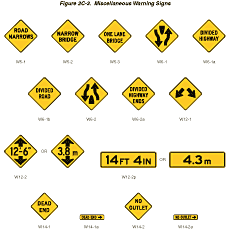
A ROAD NARROWS (W5-1) sign (see Figure 2C-3) should be used in advance
of a transition on two-lane roads where the pavement width is reduced
abruptly to a width such that vehicles might not be able to pass
without reducing speed.
Figure 2C-3 Miscellaneous Warning Signs
Option:
Additional emphasis may be provided by the use of object markers
and delineators (see Chapters 3C and 3D). The Advisory Speed (W13-1)
plaque (see Section 2C.46) may be used
to indicate the recommended speed.
Section 2C.16 NARROW BRIDGE Sign (W5-2)
Guidance:
A NARROW BRIDGE (W5-2) sign (see Figure 2C-3)
should be used in advance of any bridge or culvert having a two-way
roadway clearance width of 4.9 to 5.5 m (16 to 18 ft), or any bridge
or culvert having a roadway clearance less than the width of the
approach travel lanes.
Additional emphasis should be provided by the use of object markers, delineators, and/or pavement markings.
Option:
A NARROW BRIDGE sign may be used in advance of a bridge or culvert
on which the approach shoulders are narrowed or eliminated.
Section 2C.17 ONE LANE BRIDGE Sign (W5-3)
Guidance:
A ONE LANE BRIDGE (W5-3) sign (see Figure 2C-3) should be used on
two-way roadways in advance of any bridge or culvert:
- Having a clear roadway width of less than 4.9 m (16 ft); or
- Having a clear roadway width of less than 5.5 m (18 ft) when commercial vehicles constitute a high proportion of the traffic; or
- Having a clear roadway width of 5.5 m (18 ft) or less where the sight distance is limited on the approach to the structure.
Additional emphasis should be provided by the use of object markers, delineators, and/or pavement markings.
Section 2C.18 Divided Highway (Road) Sign (W6-1)
Guidance:
A Divided Highway (W6-1) symbol sign (see Figure 2C-3) should be
used on the approaches to a section of highway (not an intersection
or junction) where the opposing flows of traffic are separated by
a median or other physical barrier.
Option:
The word message DIVIDED HIGHWAY (W6-1a) or DIVIDED ROAD (W6-1b)
sign (see Figure 2C-3) may be used as an alternate to the symbol
sign.
Section 2C.19 Divided Highway (Road) Ends Sign (W6-2)
Guidance:
A Divided Highway Ends (W6-2) symbol sign (see Figure 2C-3) should
be used in advance of the end of a section of physically divided
highway (not an intersection or junction) as a warning of two-way
traffic ahead.
Option:
The Two-Way Traffic (W6-3) symbol sign (see Section
2C.34) may be used to give warning and notice of the transition
to a two-lane, two-way section.
The word message DIVIDED HIGHWAY ENDS (W6-2a) or DIVIDED ROAD ENDS (W6-2b) sign (see Figure 2C-3) may be used as an alternate to the symbol sign.
Section 2C.20 Double Arrow Sign (W12-1)
Option:
The Double Arrow (W12-1) sign (see Figure 2C-3) may be used to advise
road users that traffic is permitted to pass on either side of an
island, obstruction, or gore in the roadway. Traffic separated by
this sign may either rejoin or change directions.
Guidance:
If used on an island, the Double Arrow sign should be mounted near
the approach end.
If used in front of a pier or obstruction, the Double Arrow sign should be mounted on the face of, or just in front of, the obstruction. Where stripe markings are used on the obstruction, they should be discontinued to leave a 75 mm (3 in) space around the outside of the sign.
Section 2C.21 DEAD END/NO OUTLET Signs (W14-1, W14-1a, W14-2, W14-2a)
Option:
The DEAD END (W14-1) sign (see Figure 2C-3) may be used at the entrance
of a single road or street that terminates in a dead end or cul-de-sac.
The NO OUTLET (W14-2) sign may be used at the entrance to a road
or road network from which there is no other exit.
DEAD END (W14-1a) or NO OUTLET (W14-2a) signs (see Figure 2C-3) may be used in combination with Street Name (D3-1) signs (see Section 2D.38) to warn turning traffic that the cross street ends in the direction indicated by the arrow.
At locations where the cross street does not have a name, the W14-1a or W14-2a signs may be used alone in place of a street name sign.
Standard:
When the W14-1 or W14-2 sign is used, the sign shall be posted as
near as practical to the entry point or at a sufficient advance
distance to permit the road user to avoid the dead end or no outlet
condition by turning off, if possible, at the nearest intersecting
street.
The DEAD END (W14-1a) or NO OUTLET (W14-2a) signs shall not be used instead of the W14-1 or W14-2 signs where traffic can proceed straight through the intersection into the dead end street or no outlet area.
Section 2C.22 Low Clearance Signs (W12-2 and W12-2p)
Standard:
The Low Clearance (W12-2) sign (see Figure
2C-3) shall be used to warn road users of clearances less than
300 mm (12 in) above the statutory maximum vehicle height.
Guidance:
The actual clearance should be shown on the Low Clearance sign to
the nearest 25 mm (1 in) not exceeding the actual clearance. However,
in areas that experience changes in temperature causing frost action,
a reduction, not exceeding 75 mm (3 in), should be used for this
condition.
Where the clearance is less than the legal maximum vehicle height, the W12-2 sign with a supplemental distance plaque should be placed at the nearest intersecting road or wide point in the road at which a vehicle can detour or turn around.
In the case of an arch or other structure under which the clearance varies greatly, two or more signs should be used as necessary on the structure itself to give information as to the clearances over the entire roadway.
Clearances should be evaluated periodically, particularly when resurfacing operations have occurred.
Option:
The Low Clearance sign may be installed on or in advance of the
structure. If a sign is placed on the structure, it may be a rectangular
shape (W12-2p) with the appropriate legend (see Figure 2C-3).
Section 2C.23 BUMP and DIP Signs (W8-1, W8-2)
Guidance:
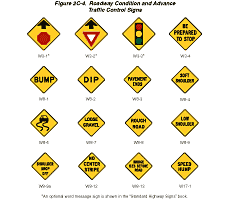
BUMP (W8-1) and DIP (W8-2) signs (see Figure
2C-4) should be used to give warning of a sharp rise or depression
in the profile of the road.
Option:
These signs may be supplemented with an Advisory Speed plaque (see
Section 2C.46).
Standard:
The DIP sign shall not be used at a short stretch of depressed alignment
that might momentarily hide a vehicle.
Guidance:
A short stretch of depressed alignment that might momentarily hide
a vehicle should be treated as a no-passing zone when centerline
striping is provided on a two-lane or three-lane road (see Section
3B.02).
Section 2C.24 SPEED HUMP Sign (W17-1)
Guidance:
The SPEED HUMP (W17-1) sign (see Figure 2C-4) should be used to
give warning of a vertical deflection in the roadway that is designed
to limit the speed of traffic.
Figure 2C-4 Roadway Condition and Advance Traffic Control Signs
If used, the SPEED HUMP sign should be supplemented by an Advisory Speed plaque (see Section 2C.46).
Option:
If a series of speed humps exists in close proximity, an Advisory
Speed plaque may be eliminated on all but the first SPEED HUMP sign
in the series.
The legend SPEED BUMP may be used instead of the legend SPEED HUMP on the W17-1 sign.
Support:
Speed humps generally provide more gradual vertical deflection than
speed bumps. Speed bumps limit the speed of traffic more severely
than speed humps. However, this difference in engineering terminology
is not well known by the public, so for signing purposes the terms
are interchangeable.
Section 2C.25 PAVEMENT ENDS Sign (W8-3)
Guidance:
A PAVEMENT ENDS (W8-3) word message sign (see Figure
2C-4) should be used where a paved surface changes to either
a gravel treated surface or an earth road surface.
Option:
An Advisory Speed plaque (see Section 2C.46)
may be used when the change in roadway condition requires a reduced
speed.
Section 2C.26 Shoulder Signs (W8-4, W8-9, and W8-9a)
Option:
The SOFT SHOULDER (W8-4) sign (see Figure 2C-4) may be used to warn
of a soft shoulder condition.
The LOW SHOULDER (W8-9) sign (see Figure 2C-4) may be used to warn of a shoulder condition where there is an elevation difference of less than 75 mm (3 in) between the shoulder and the travel lane.
Guidance:
The SHOULDER DROP OFF (W8-9a) sign (see Figure 2C-4) should be used
when an unprotected shoulder drop-off, adjacent to the travel lane,
exceeds 75 mm (3 in) in depth for a significant continuous length
along the roadway, based on engineering judgment.
Additional shoulder signs should be placed at appropriate intervals along the road where the condition continually exists.
Standard:
When used, shoulder signs shall be placed in advance of the condition
(see Table 2C-4).
Section 2C.27 Slippery When Wet Sign (W8-5)
Option:
The Slippery When Wet (W8-5) sign (see Figure 2C-4) may be used
to warn that a slippery condition might exist.
Guidance:
When used, a Slippery When Wet sign should be placed in advance
of the beginning of the affected section (see Table 2C-4), and additional
signs should be placed at appropriate intervals along the road where
the condition exists.
Section 2C.28 BRIDGE ICES BEFORE ROAD Sign (W8-13)
Option:
A BRIDGE ICES BEFORE ROAD (W8-13) sign (see Figure 2C-4) may be
used in advance of bridges to advise bridge users of winter weather
conditions.
The BRIDGE ICES BEFORE ROAD sign may be removed or covered during seasons of the year when its message is not relevant.
Section 2C.29 Advance Traffic Control Signs (W3-1, W3-2, W3-3, W3-4)
Standard:
The Advance Traffic Control symbol signs (see Figure 2C-4) include
the Stop Ahead (W3-1), Yield Ahead (W3-2), and Signal Ahead (W3-3)
signs. These signs shall be installed on an approach to a primary
traffic control device that is not visible for a sufficient distance
to permit the road user to respond to the device (see Table 2C-4).
The visibility criteria for a traffic control signal shall be based
on having a continuous view of at least two signal faces for the
distance specified in Table
4D-1.
Support:
Permanent obstructions causing the limited visibility might include
roadway alignment or structures. Intermittent obstructions might
include foliage or parked vehicles.
Guidance:
Where intermittent obstructions occur, engineering judgment should
determine the treatment to be implemented.
Option:
An Advance Traffic Control sign may be used for additional emphasis
of the primary traffic control device, even when the visibility
distance to the device is satisfactory.
Word messages (W3-1a, W3-2a, W3-3a) may be used as alternates to the Advance Traffic Control symbol signs.
A supplemental street name plaque (see Section 2C.49) may be installed above or below an Advance Traffic Control sign.
A warning beacon may be used with an Advance Traffic Control sign.
A BE PREPARED TO STOP (W3-4) sign (see Figure 2C-4) may be used to warn of stopped traffic caused by a traffic control signal or in advance of a section of roadway that regularly experiences traffic congestion.
Standard:
When a BE PREPARED TO STOP sign is used in advance of a traffic
control signal, it shall be used in addition to a Signal Ahead sign.
Option:
The BE PREPARED TO STOP sign may be supplemented with a warning
beacon (see Section 4K.03).
Guidance:
When the warning beacon is interconnected with a traffic control
signal or queue detection system, the BE PREPARED TO STOP sign should
be supplemented with a WHEN FLASHING plaque.
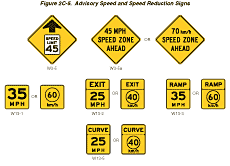
Section 2C.30 Speed Reduction Signs (W3-5, W3-5a)
Guidance:
A Speed Reduction (W3-5 or W3-5a) sign (see Figure 2C-5) should
be used to inform road users of a reduced speed zone when engineering
judgment indicates the need for advance notice to comply with the
posted speed limit ahead.
Figure 2C-5 Advisory Speed and Speed Reduction Signs
Standard:
If used, Speed Reduction signs shall be followed by a Speed Limit
(R2-1) sign installed at the beginning of the zone where the speed
limit applies.
The speed limit displayed on the Speed Reduction sign shall be identical to the speed limit displayed on the subsequent Speed Limit sign.
Section 2C.31 Merge Signs (W4-1, W4-5)
Option:
A Merge (W4-1) sign (see Figure 2C-6) may be used to warn road users
on the major roadway that merging movements might be encountered
in advance of a point where lanes from two separate roadways converge
as a single traffic lane and no turning conflict occurs.
A Merge sign may also be installed on the side of the entering roadway to warn road users on the entering roadway of the merge condition.
Guidance:
The Merge sign should be installed on the side of the major roadway
where merging traffic will be encountered and in such a position
as to not obstruct the road user's view of entering traffic.
Where two roadways of approximately equal importance converge, a Merge sign should be placed on each roadway.
When a Merge sign is to be installed on an entering roadway that curves before merging with the major roadway, such as a ramp with a curving horizontal alignment as it approaches the major roadway, the Entering Roadway Merge (W4-5) sign (see Figure 2C-6) should be used to better portray the actual geometric conditions to road users on the entering roadway.
The Merge sign should not be used where two roadways converge and merging movements are not required.
The Merge sign should not be used in place of a Lane Ends sign where lanes of traffic moving on a single roadway must merge because of a reduction in the actual or usable pavement width (see Section 2C.33).
Section 2C.32 Added Lane Signs (W4-3, W4-6)
Guidance:
The Added Lane (W4-3) sign (see Figure 2C-6)
should be installed in advance of a point where two roadways converge
and merging movements are not required. When possible, the Added
Lane sign should be placed such that it is visible from both roadways;
if this is not possible, an Added Lane sign should be placed on
the side of each roadway.
When an Added Lane sign is to be installed on a roadway that curves before converging with another roadway that has a tangent alignment at the point of convergence, the Entering Roadway Added Lane (W4-6) sign (see Figure 2C-6) should be used to better portray the actual geometric conditions to road users on the curving roadway.
Section 2C.33 Lane Ends Signs (W4-2, W9-1, W9-2)
Guidance:
The LANE ENDS MERGE LEFT (RIGHT) (W9-2) word sign, or the Lane Ends
(W4-2) symbol sign, should be used to warn of the reduction in the
number of traffic lanes in the direction of travel on a multi-lane
highway (see Figure 2C-6).
Figure 2C-6 Merging and Passing Signs
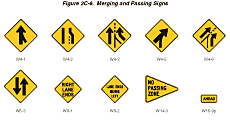
Option:
The RIGHT (LEFT) LANE ENDS (W9-1) word sign (see Figure 2C-6) may
be used in advance of the Lane Ends (W4-2) symbol sign or the LANE
ENDS MERGE LEFT (RIGHT) (W9-2) word sign as additional warning or
to emphasize that the traffic lane is ending and that a merging
maneuver will be required.
On one-way streets or on divided highways where the width of the median will permit, two Lane Ends signs may be placed facing approaching traffic, one on the right side and the other on the left side or median.
The reduction in the number of traffic lanes may also be delineated with roadway edge lines (see Section 3B.09) and/or roadway delineation (see Chapter 3D).
Guidance:
Where an extra lane has been provided for slower moving traffic
(see Section 2B.32), a Lane
Ends word sign or a Lane Ends (W4-2) symbol sign should be installed
in advance of the end of the extra lane.
Lane Ends signs should not be installed in advance of the end of an acceleration lane.
Section 2C.34 Two-Way Traffic Sign (W6-3)
Guidance:
A Two-Way Traffic (W6-3) sign (see Figure 2C-6) should be used to
warn road users of a transition from a multi-lane divided section
of roadway to a two-lane, two-way section of roadway.
A Two-Way Traffic (W6-3) sign with an AHEAD (W16-9p) plaque (see Figure 2C-6) should be used to warn road users of a transition from a one-way street to a two-lane, two-way section of roadway (see Figure 2B-12, Sheet 2 of 2).
Option:
The Two-Way Traffic sign may be used at intervals along a two-lane,
two-way roadway and may be used to supplement the Divided Highway
(Road) Ends (W6-2) sign discussed in Section
2C.19.
Section 2C.35 NO PASSING ZONE Sign (W14-3)
Standard:
The NO PASSING ZONE (W14-3) sign (see Figure 2C-6) shall be a pennant-shaped
isosceles triangle with its longer axis horizontal and pointing
to the right. When used, the NO PASSING ZONE sign shall be installed
on the left side of the roadway at the beginning of no-passing zones
identified by either pavement markings or DO NOT PASS signs or both
(see Sections 2B.29
and 3B.02).
Section 2C.36 Advisory Exit, Ramp, and Curve Speed Signs (W13-2, W13-3, W13-5)
Standard:
Advisory Exit, Ramp, and Curve Speed signs shall be vertical rectangles.
The advisory Exit Speed (W13-2), Ramp Speed (W13-3), or Curve Speed
(W13-5) signs (see Figure 2C-5) shall be used where engineering
judgment indicates the need to advise road users of the recommended
speed on an exit, a ramp, or a curve.
Guidance:
When used, the Exit Speed sign should be installed along the deceleration
lane.
The Exit Speed sign should be visible in time for the road user to make a reasonably safe slowing and exiting maneuver.
The Ramp Speed sign should be visible in time for the road user to reduce to the recommended speed.
Option:
One or more Ramp Speed signs may be used along the deceleration
lane beyond the gore, or along the ramp (see Figure 2C-7). Based
on engineering judgment, the Ramp Speed sign may be installed on
the inside or outside of the curve to enhance its visibility.
Figure 2C-7 Example of Advisory Speed Signing for an Exit Ramp
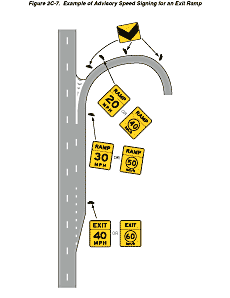
A Turn (W1-1) or Curve (W1-2) sign with an Advisory Speed (W13-1) plaque may be used in place of a Ramp Speed sign if it is located such that it clearly does not apply to drivers on the main roadway.
A Curve Speed sign may be used at and beyond the beginning of a curve following a Horizontal Alignment and Advisory Speed sign combination, or when there is a need to remind road users of the recommended speed, or where the recommended speed changes because of a change in curvature (see Section 2C.06). Based on engineering judgement, the Curve Speed sign may be installed on the inside or outside of the curve to enhance its visibility.
The advisory speed may be the 85th-percentile speed of free-flowing traffic, the speed corresponding to a 16-degree ball bank indicator reading, or the speed otherwise determined by an engineering study because of unusual circumstances.
Support:
A 10-degree ball-bank indicator reading, formerly
used in determining advisory speeds, is based on research from the
1930s. In modern vehicles, the 85th-percentile speed on curves approximates
a 16-degree reading. This is the speed at which most drivers' judgment
recognizes incipient instability along a ramp or curve.
Section 2C.37 Intersection Warning Signs (W2-1 through W2-6)
Option:
A Cross Road (W2-1) symbol, Side Road (W2-2 or W2-3) symbol, T-Symbol
(W2-4), or Y-Symbol (W2-5) sign (see Figure 2C-8) may be used in
advance of an intersection to indicate the presence of an intersection
and the possibility of turning or entering traffic. The Circular
Intersection (W2-6) symbol sign accompanied by an educational TRAFFIC
CIRCLE (W16-12p) plaque (see Figure 2C-8) may be installed in advance
of a circular intersection.
Figure 2C-8 Intersection Warning Signs
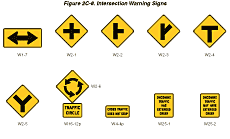
The relative importance of the intersecting roadways may be shown by different widths of lines in the symbol.
An advance street name plaque (see Section 2C.49) may be installed above or below an Intersection Warning sign.
Guidance:
The Intersection Warning sign should illustrate and depict the general
configuration of the intersecting roadway, such as cross road, side
road, T-intersection, or Y-intersection.
Intersection Warning signs, other than the Circular Intersection symbol (W2-6) sign and the T-intersection symbol (W2-4) sign, should not be used on approaches controlled by STOP signs, YIELD signs, or signals. The Circular Intersection symbol (W2-6) sign should be installed on the approach to a YIELD sign controlled roundabout intersection.
Where the side roads are not opposite of each other, the symbol for the intersection should indicate a slight offset.
Section 2C.38 Two-Direction Large Arrow Sign (W1-7)
Standard:
The Two-Direction Large Arrow (W1-7) sign (see Figure 2C-8) shall
be a horizontal rectangle.
If used, it shall be installed on the far side of a T-intersection in line with, and at approximately a right angle to, approaching traffic.
The Two-Direction Large Arrow sign shall not be used where there is no change in the direction of travel such as at the beginnings and ends of medians or at center piers.
Guidance:
The Two-Direction Large Arrow sign should be visible for a sufficient
distance to provide the road user with adequate time to react to
the intersection configuration.
Section 2C.39 Traffic Signal Signs (W25-1, W25-2)
Standard:
Unless a separate left-turn signal face is provided and is operated
as described in Section
4D.06, if the possibility exists that a CIRCULAR YELLOW signal
indication could be displayed to an approach from which drivers
are turning left permissively without the simultaneous display of
a CIRCULAR YELLOW signal indication to the opposing approach (see
Section 4D.05), either
a W25-1 or a W25-2 sign (see Figure 2C-8)
shall be installed near the left-most signal head. If the operation
described in the previous sentence occurs on a cycle-by-cycle basis
during all times that the traffic control signal is operated in
the stop-and-go mode, the ONCOMING TRAFFIC HAS EXTENDED GREEN (W25-1)
sign shall be used; if the operation occurs only occasionally, the
ONCOMING TRAFFIC MAY HAVE EXTENDED GREEN (W25-2) sign shall be used.
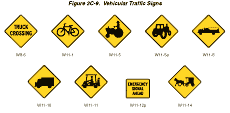
Section 2C.40 Vehicular Traffic Signs (W8-6, W11-1, W11-5, W11-5a, W11-8, W11-10, W11-11, W11-12p, W11-14)
Option:
Vehicular Traffic (W8-6, W11-1, W11-5, W11-5a, W11-8, W11-10, W11-11,
W11-12p, W11-14) signs (see Figure 2C-9) may be used to alert road
users to locations where unexpected entries into the roadway by
trucks, bicyclists, farm vehicles, emergency vehicles, golf carts,
horse-drawn vehicles, or other vehicles might occur. The TRUCK CROSSING
(W8-6) word message sign may be used as an alternate to the Truck
Crossing symbol (W11-10) sign.
Figure 2C-9 Vehicular Traffic Signs
Support:
These locations might be relatively confined or might occur randomly
over a segment of roadway.
Guidance:
Vehicular Traffic signs should be used only at locations where the
road user's sight distance is restricted, or the condition, activity,
or entering traffic would be unexpected.
If the condition or activity is seasonal or temporary, the Vehicular Traffic sign should be removed or covered when the condition or activity does not exist.
Option:
Supplemental plaques (see Section 2C.43)
with legends such as AHEAD, XX METERS (XX FEET), NEXT XX km (NEXT
XX MILES), or SHARE THE ROAD may be mounted below Vehicular Traffic
signs to provide advance notice to road users of unexpected entries.
Standard:
The Emergency Vehicle (W11-8) sign with the EMERGENCY SIGNAL AHEAD
(W11-12p) supplemental plaque (see Figure 2C-9)
shall be placed in advance of all emergency-vehicle traffic control
signals (see Chapter 4F).
Option:
The Emergency Vehicle (W11-8) sign, or a word message sign indicating
the type of emergency vehicle (such as rescue squad), may be used
in advance of the emergency vehicle station when no emergency-vehicle
traffic control signal is present.
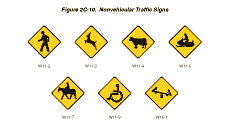
Section 2C.41 Nonvehicular Signs (W11-2, W11-3, W11-4, W11-6, W11-7, W11-9)
Option:
Nonvehicular signs (see Figure 2C-10) may be used to alert road
users in advance of locations where unexpected entries into the
roadway or shared use of the roadway by pedestrians, animals, and
other crossing activities might occur.
Figure 2C-10 Nonvehicular Traffic Signs
Support:
These conflicts might be relatively confined, or might occur randomly
over a segment of roadway.
Option:
When used in advance of a crossing, Nonvehicular warning signs may
be supplemented with supplemental plaques (see Section
2C.43) with the legend AHEAD, XX METERS (XX FEET), or NEXT XX
km (NEXT XX MILES) to provide advance notice to road users of crossing
activity.
Standard:
When used at the crossing, Nonvehicular signs shall be supplemented
with a diagonal downward pointing arrow (W16-7p) plaque (see Figure
2C-11) showing the location of the crossing.
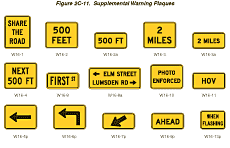
Figure 2C-11 Supplemental Warning Plaques
Option:
The crossing location may be defined with crosswalk markings (see
Section 3B.17).
Pedestrian, Bicycle, and School signs and their related supplemental plaques may have a fluorescent yellow-green background with a black legend and border.
Guidance:
When a fluorescent yellow-green background is used, a systematic
approach featuring one background color within a zone or area should
be used. The mixing of standard yellow and fluorescent yellow-green
backgrounds within a selected site area should be avoided.
Nonvehicular signs should be used only at locations where the crossing activity is unexpected or at locations not readily apparent.
Section 2C.42 Playground Sign (W15-1)
Option:
The Playground (W15-1) sign (see Figure 2C-10) may be used to give
advance warning of a designated children's playground that is located
adjacent to the road. The Playground sign may have a fluorescent
yellow-green background with a black legend and border.
Guidance:
If the access to the playground area requires a roadway crossing,
the application of crosswalk pavement markings (see Section
3B.17) and Nonvehicular signs (see Section
2C.41) should be considered.
Section 2C.43 Use of Supplemental Plaques
Option:
A supplemental plaque may be displayed with a warning sign when
engineering judgment indicates that road users require additional
information beyond that contained in the main message of the warning
sign.
Standard:
Supplemental plaques shall be used only in combination with warning
or regulatory signs. They shall not be mounted alone or displayed
alone. If used, a supplemental plaque shall be installed on the
same post(s) as the warning sign.
Section 2C.44 Design of Supplemental Plaques
Standard:
A supplemental plaque shall have the same color legend, border,
and background as the warning sign with which it is displayed. Supplemental
plaques shall be square or rectangular.
Section 2C.45 Distance Plaques (W16-2 series, W16-3 series, W16-4, W7-3a)
Option:
The Distance Ahead (W16-2 series and W16-3 series) plaques (see
Figure 2C-11) may be used to inform the road user of the distance
to the condition indicated by the warning sign.
The Next Distance (W7-3a and W16-4) plaques (see Figures 2C-2 and 2C-11) may be used to inform road users of the length of roadway over which the condition indicated by the warning sign exists.
Section 2C.46 Advisory Speed Plaque (W13-1)
Option:
The Advisory Speed (W13-1) plaque (see Figure
2C-5) may be used to supplement any warning sign to indicate
the advisory speed for a condition.
Standard:
The Advisory Speed plaque shall be used where an engineering study
indicates a need to advise road users of the advisory speed for
a condition.
If used, the Advisory Speed plaque shall carry the message XX km/h (XX MPH). The speed shown shall be a multiple of 10 km/h or 5 mph.
Except in emergencies or when the condition is temporary, an Advisory Speed plaque shall not be installed until the advisory speed has been determined by an engineering study.
Guidance:
Because changes in conditions, such as roadway geometrics, surface
characteristics, or sight distance, might affect the advisory speed,
each location should be periodically evaluated and the Advisory
Speed plaque changed if necessary.
Option:
The advisory speed may be the 85th-percentile speed of free-flowing
traffic, the speed corresponding to a 16-degree ball bank indicator
reading, or the speed otherwise determined by an engineering study
because of unusual circumstances.
Support:
A 10-degree ball-bank indicator reading, formerly
used in determining advisory speeds, is based on research from the
1930s. In modern vehicles, the 85th-percentile speed on curves approximates
a 16-degree reading. This is the speed at which most drivers' judgment
recognizes incipient instability along a ramp or curve.
Section 2C.47 Supplemental Arrow Plaques (W16-5p, W16-6p, W16-7p)
Guidance:
If the condition indicated by a warning sign is located on an intersecting
road and the distance between the intersection and condition is
not sufficient to provide adequate advance placement of the warning
sign, a Supplemental Arrow (W16-5p, W16-6p, W16-7p) plaque (see
Figure 2C-11) should be used below the
warning sign.
Standard:
Supplemental Arrow plaques (see Figure 2C-2)
shall have the same legend design as the Advance Turn Arrow and
Directional Arrow auxiliary signs (see Sections 2D.25
and 2D.26)
except that they shall have a black legend and border on a yellow
or fluorescent yellow-green background, as appropriate.
Section 2C.48 Hill-Related Plaques (W7-2 Series, W7-3 Series)
Guidance:
Hill-Related (W7-2 series, W7-3 series) plaques (see Figure
2C-11) or other appropriate legends and larger signs should
be used for emphasis or where special hill characteristics exist.
On longer grades, the use of the distance plaque (W7-3a or W7-3b) at periodic intervals of approximately 1.6 km (1 mi) spacing should be considered.
Section 2C.49 Advance Street Name Plaque (W16-8, W16-8a)
Option:
An Advance Street Name (W16-8 or W16-8a) plaque (see Figure 2C-11)
may be used with any Intersection sign (W2 series) or Advance Traffic
Control (W3 series) sign to identify the name of the intersecting
street.
Section 2C.50 CROSS TRAFFIC DOES NOT STOP Plaque (W4-4p)
Option:
The CROSS TRAFFIC DOES NOT STOP (W4-4p) plaque
(see Figure 2C-8) may be used in combination
with a STOP sign when engineering judgment indicates that conditions
are present that are causing or could cause drivers to misinterpret
the intersection as an all-way stop.
Alternate messages such as TRAFFIC FROM LEFT (RIGHT) DOES NOT STOP or ONCOMING TRAFFIC DOES NOT STOP may be used on the W4-4p plaque when such messages more accurately describe the traffic controls established at the intersection.
Standard:
If the W4-4p plaque is used, it shall be installed below the STOP
sign.
Section 2C.51 SHARE THE ROAD Plaque (W16-1)
Option:
In situations where there is a need to warn drivers to watch for
other slower forms of transportation traveling along the highway,
such as bicycles, golf carts, horse-drawn vehicles, or farm machinery,
a SHARE THE ROAD (W16-1) plaque (see Figure 2C-11) may be used.
Section 2C.52 High-Occupancy Vehicle (HOV) Plaque (W16-11)
Option:
In situations where there is a need to warn drivers in an HOV lane
of a specific condition, a HOV (W16-11) plaque (see Figure 2C-11)
may be used. The HOV plaque may be used to differentiate a warning
sign specific for HOV lanes when the sign is also visible to traffic
on the adjoining general purpose roadway. Among the warning signs
that may be possible applications of the HOV plaque are the Advisory
Speed, Advisory Exit Speed, Added Lane, and Merge signs.
The diamond symbol may be used instead of the word message HOV on the W16-11 plaque. When appropriate, the words LANE or ONLY may be used on this plaque.
Section 2C.53 PHOTO ENFORCED Plaque (W16-10)
Option:
A PHOTO ENFORCED (W16-10) plaque (see Figure 2C-11) may be mounted
below a warning sign to advise road users that the regulations associated
with the condition being warned about (such as a traffic control
signal or a toll plaza) are being enforced by photographic equipment.
Standard:
If used below a warning sign, the PHOTO ENFORCED plaque shall be
a rectangle with a black legend and border on a yellow background.
